
For runners · VRTX grip socks
Your shoe moves. Your foot moves. Not together.
VRTX grip socks. £15.95 a pair. Built so foot, sock and shoe move as one.


Before the list

Your foot and your shoe do not move as one
In ordinary, straight-line running, the shoe and the bones of your foot move differently on every stride.
In 1997, a Swiss research team did something no shoe advert will ever show you. They fixed pins to the bones of runners’ feet and measured what the shoe did around them (Reinschmidt et al., 1997).
The shoe went one way. The bones went another. Not on turns. Not on trails. Stride after stride. A second team repeated the experiment in 2000 and found the same thing (Stacoff et al., 2000).
You never feel it as sliding. You feel what it leaves behind:
- The hot spot that shows up at the same mile of every long run
- The sock that needs pulling straight at the lights
- The heel that lifts a fraction on every climb
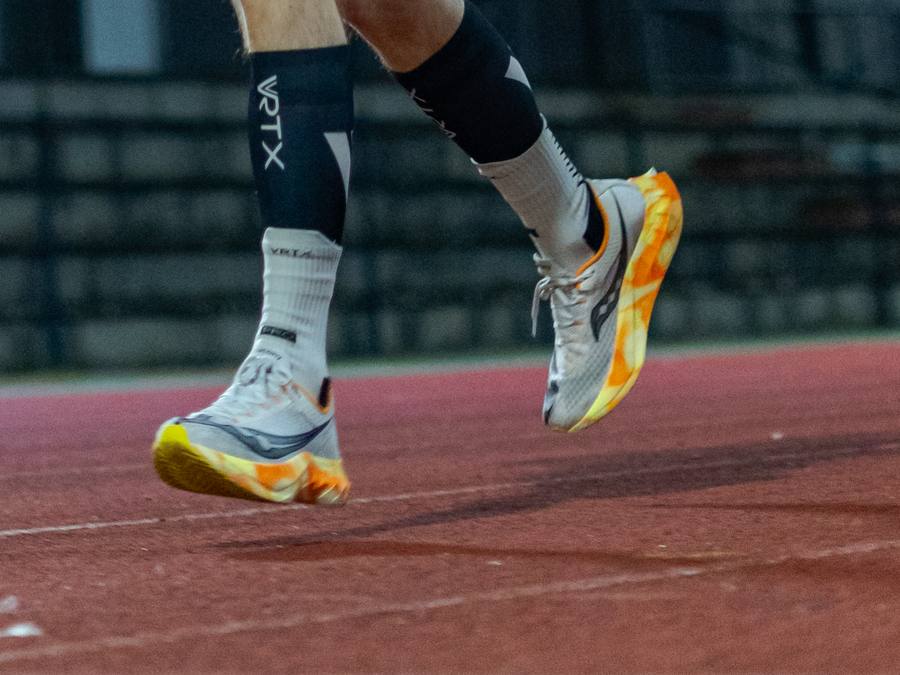
If your foot did not move in there, nobody would need a runner’s knot
You already fight this with your laces. The sock is the layer the laces cannot reach.
There is a spare eyelet at the top of your trainer. You have probably used it: loop the lace, thread the heel lock, cinch it down. Runners teach it to each other because it works, and it works because it fights something real.
But the knot holds the shoe to the foot from the outside. It cannot reach the inside, where a layer of fabric sits between your foot and the insole with nothing holding it to either.
A grip sock does not replace a runner’s knot. It finishes the job at the layer the laces cannot reach.

Your running socks were built for a different job
72% of UK runners already wear specialist running socks. None of them promise to hold the sock to the shoe.
When 212 UK runners were polled on Fetcheveryone, 72% already ran in specialist running socks. Only 8% ran in plain ones. So the odds are you have already bought well: cushioning where you want it, sweat wicked away, maybe a snug arch band.
Read the packet, though. Every promise on it is about comfort and moisture, because that was never the brief. A running sock is built to sit between two surfaces. It was never built to join them.

The grip is on the outside. That is not a detail
Silicone grip outside holds the sock to the shoe. A midfoot band holds it to your foot.
Turn a VRTX sock sole-up. A silicone chevron pattern runs the full length of it, heel to toe, facing the shoe, not the skin. Its one job is to hold the sock to the insole.
Inside the sock, a midfoot support band wraps the arch and holds the sock to your foot.
Two mechanisms. One result: foot, sock and shoe move as one unit.

The people who doubted it put it best:

They do not feel how you are picturing them
The grip faces the shoe. Against your skin there is only knitted fabric.
“Grip sock” puts a picture in your head: stiff studio socks, rubber nubs under your arch for three hours of road. That picture is the wrong way round. The chevrons face outward, into the shoe. Against your skin there is only knitted fabric, cushioned at the heel and forefoot, where a running foot actually lands. Nothing textured touches you.
We are not going to tell you what that feels like at mile ten. Ayda can:
Reason 06
A grip sock at running-sock money
£15.95 a pair. The same money as the running socks you already buy.
The specialist running socks you already buy run £13 to £21 a pair. VRTX is £15.95. Same money, one extra job.
We will not dress that up as a flash sale. It is £7.95 off for buying what most people buy anyway: over half of our last 250 orders were the three-pack.

Two sizes. Pick like this
Snug is correct. Between sizes, go small.
S fits UK 3 to 7. L fits UK 8 to 11. The rule we repeat most in customer service:
- Snug is correct
- Between sizes, go small, then pull them up fully
- Too big is worse than a plain sock: the chevrons belong flat under your sole, and in a loose sock they ride up round the heel and the fabric folds under you
If your heel never lifts and you have never once had a hot spot, your setup already works and we would rather you kept it.
If your race shoe is cut so tight that a thicker sock changes the fit, try these in training first, not on race day.
And if you are shopping for a blister guarantee, that is not us. We do not promise you will never blister. Nobody honest can.
One more honest edge: the published testing on grip socks comes from court sports, not distance running. What running has is the mechanism above, and the reviews below.
The part we cannot say ourselves
200+ reviews. These are the ones about running.


Straight answers
What runners ask us
Aren’t grip socks just for football?
They started there. VRTX built them for athletes who cover real distance: cushioned at heel and forefoot, knit upper, grip there to hold your foot rather than pad it. As one runner put it: “I could only really find ones aimed for footballers… These have been the best to keep my feet secure in my trail shoes” (Heather Jenner). The in-shoe movement they address is the same one you read about in reason 1.
Do they stop blisters?
We do not promise that, and nobody honest can. What is established: friction blisters are a shear injury, and your foot and shoe genuinely do move differently on every stride. What our customers report after switching is in the reviews below, in their own words.
Will they be too hot on a long run?
They are a training sock, not a thermal one. The upper is knit and the cushioning sits only where a running foot lands, at the heel and forefoot. Debs, after a 7km test run: “Happy they are comfortable and appropriately thick.”
I’m a UK 7.5. Which size?
Go small: the S, which fits UK 3 to 7, then pull them up fully. Snug is correct for a grip sock, and too big is worse than a plain sock. If the fit is wrong, exchanges are quick and we send the label.
£15 for socks?
The specialist running socks you already buy cost £13 to £21 a pair. VRTX is £15.95, or £13.30 a pair in the 3-pack, for the one job those socks do not do: holding the sock to the shoe.
What if they’re not for me?
Get in touch within 30 days and we will make it right, with a refund to your original payment method. We send the return label.
Foot. Sock. Shoe.
One unit.
Locked in, in the literal sense.
Over 6,500 athletes have bought a pair. The reviews stand at 4.95 from 200+.
GET YOURS · FROM £15.95